

Why a second dengue infection is more likely to be severe than the first
There are four dengue virus types. Having one type does not give lasting protection against the others, and old antibodies can make the next infection worse. How ADE explains this, and what it means for vaccines.
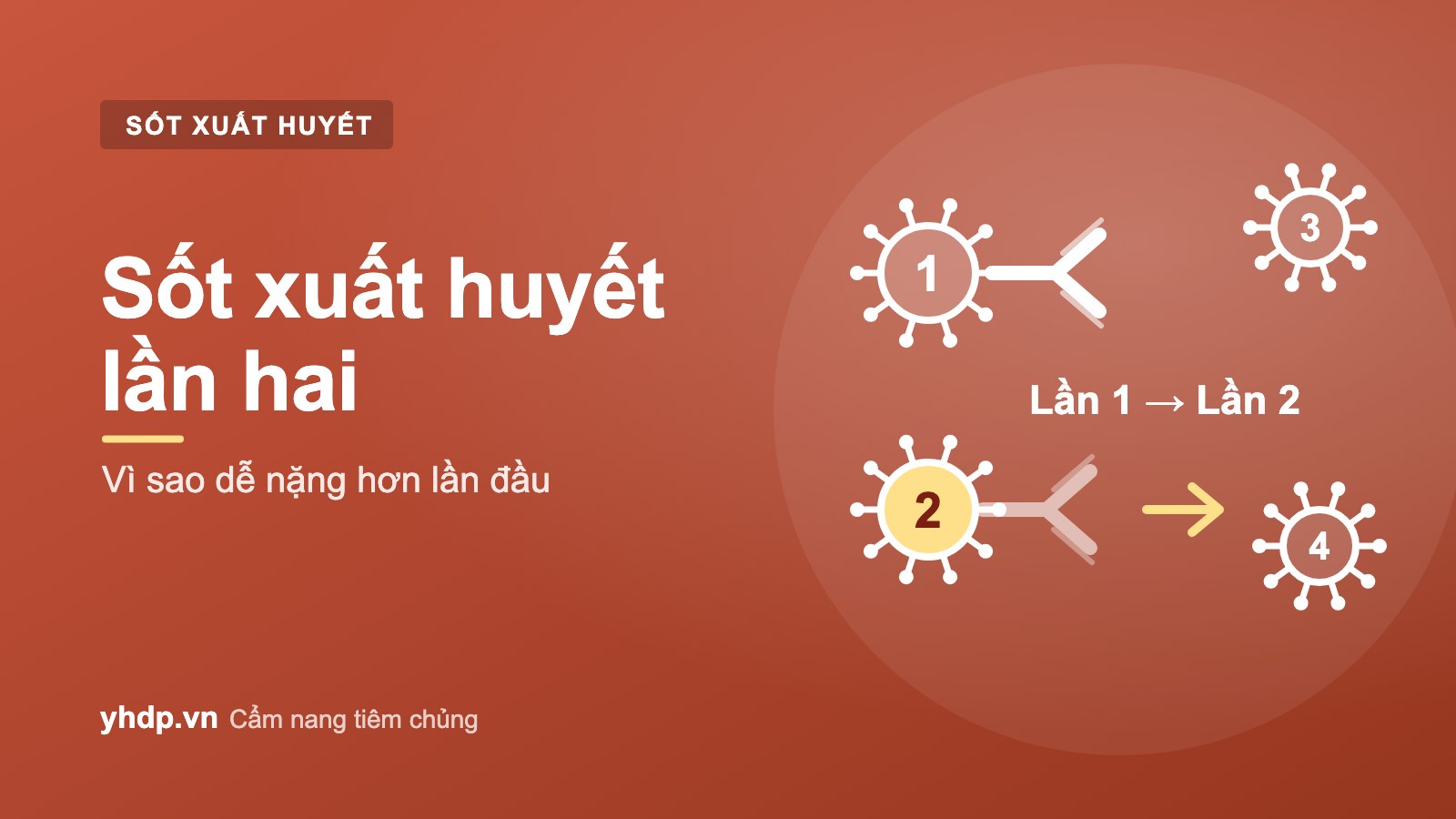
Many people who get dengue for the first time only have a fever for a few days, but the next time they develop shock or severe bleeding. The reason lies in how the immune system responds to dengue virus. This article is based on Chapters 7 and 12 of the book Dengue fever (Vietnam Association of Preventive Medicine and Vietnam General Association of Medicine; printing sponsored by Takeda Vietnam).
Four virus types, four possible infections
Dengue virus has four serotypes: DENV-1, 2, 3 and 4. After recovery, the body has long-lasting immunity to the type it was infected with. Protection against the other three types is short-lived and fades within 1–2 years. So a person can get dengue several times, each time from a different type.
The first infection is called a primary infection. A later infection with a different type is called a secondary infection. The book identifies secondary infection as the biggest risk factor for severe disease.
Source: Dengue fever (Vietnam Association of Preventive Medicine and Vietnam General Association of Medicine; printing sponsored by Takeda Vietnam), Chapter 7, sections 1.4.1 and 2.4, pp. 142, 145.
ADE: old antibodies help the new virus
ADE (antibody-dependent enhancement) means that antibodies make an infection worse. It happens like this:
- Antibodies from the previous infection recognise the new virus type and bind to it, but cannot neutralise it.
- The antibody–virus complexes are taken up by immune cells (monocytes, macrophages) through Fcγ receptors.
- Instead of being destroyed, the virus multiplies more inside these cells. Some of the cells' antiviral signals are also suppressed.
- The high viral load triggers an excessive inflammatory response that releases many cytokines. The blood vessel walls become more permeable and plasma leaks out of the vessels. This is the mechanism of severe dengue and shock.
Memory T cells from the previous infection also cross-react with the new type. They do not protect; instead they add to the excessive inflammation.
Source: Dengue fever (Vietnam Association of Preventive Medicine and Vietnam General Association of Medicine; printing sponsored by Takeda Vietnam), Chapter 7, sections 1.4.2 and 2.1, pp. 143–144.
Who is more likely to become severely ill
According to the book, most severe cases are:
- Adults with a second infection.
- Infants with a first infection whose mothers have had dengue, because the mother's antibodies pass to the baby through the placenta.
The 2026 Recommendations also list children, people with a second infection, pregnant women, older adults and people with underlying conditions as being at high risk of severe disease.
This does not mean that a first infection is always mild. Anyone with dengue needs to watch for warning signs during the critical phase.
Source: Dengue fever (Vietnam Association of Preventive Medicine and Vietnam General Association of Medicine; printing sponsored by Takeda Vietnam), Chapter 7, section 2, pp. 143–144; Recommended vaccination schedules for all ages in Vietnam (Vietnam Association of Preventive Medicine, 3rd edition, 2026), Part IV, section 2.6.1, p. 186.
ADE and vaccines
Because of ADE, the book sets a requirement: a dengue vaccine must protect evenly against all four types and must not cause this effect.
- Dengvaxia, the first vaccine, carried a risk of more severe disease in people who had never been infected. It could therefore only be given after a test confirmed previous infection. It has not been produced since January 2024.
- Qdenga, the vaccine used in Vietnam, was followed for 4.5 years in trials. No increased risk of severe disease was seen in people who had never been infected, so no test is needed before vaccination.
- Qdenga's efficacy differs by type: high against types 2 and 1, lower against types 3 and 4. The vaccine greatly reduces the risk of hospital admission, but it does not replace mosquito control and monitoring during a fever.
Source: Dengue fever (Vietnam Association of Preventive Medicine and Vietnam General Association of Medicine; printing sponsored by Takeda Vietnam), Chapter 12, sections 2.1–2.2, pp. 240–246.