


First aid straight away
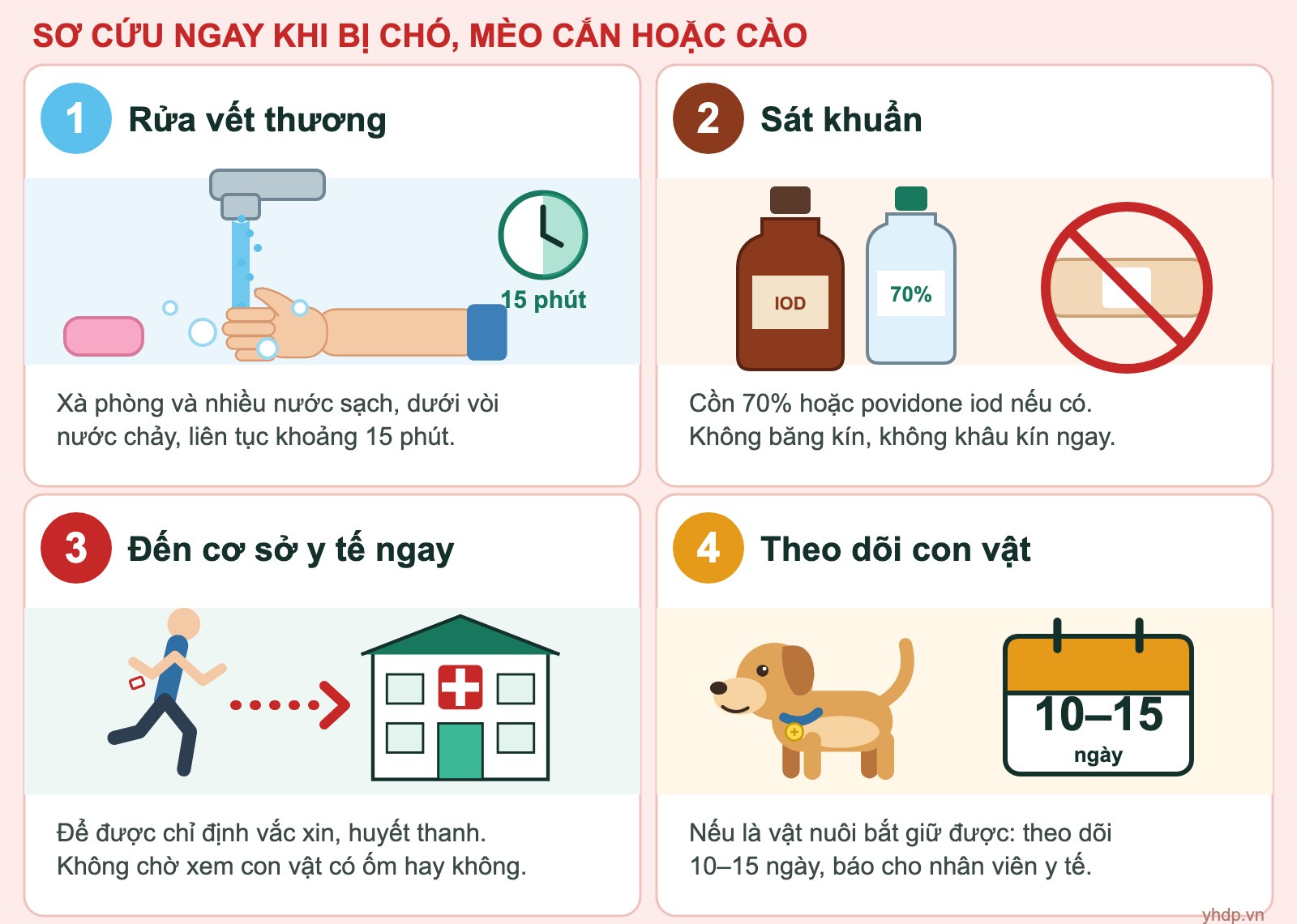
- Wash the wound immediately under running water with soap and plenty of clean water, continuously for about 15 minutes.
- Disinfect with 70% alcohol or povidone-iodine if available. Do not cover the wound tightly and do not stitch it closed straight away.
- Go to a health facility as soon as possible to have the exposure assessed and to be prescribed rabies vaccine and rabies immunoglobulin. Do not wait to see whether the animal becomes ill before getting vaccinated.
- Observe the animal (if it is a pet that can be kept) for 10–15 days and tell the health worker.
Exposure categories
A health worker assesses the exposure category to decide on post-exposure treatment. The table below follows the World Health Organization (WHO) classification.
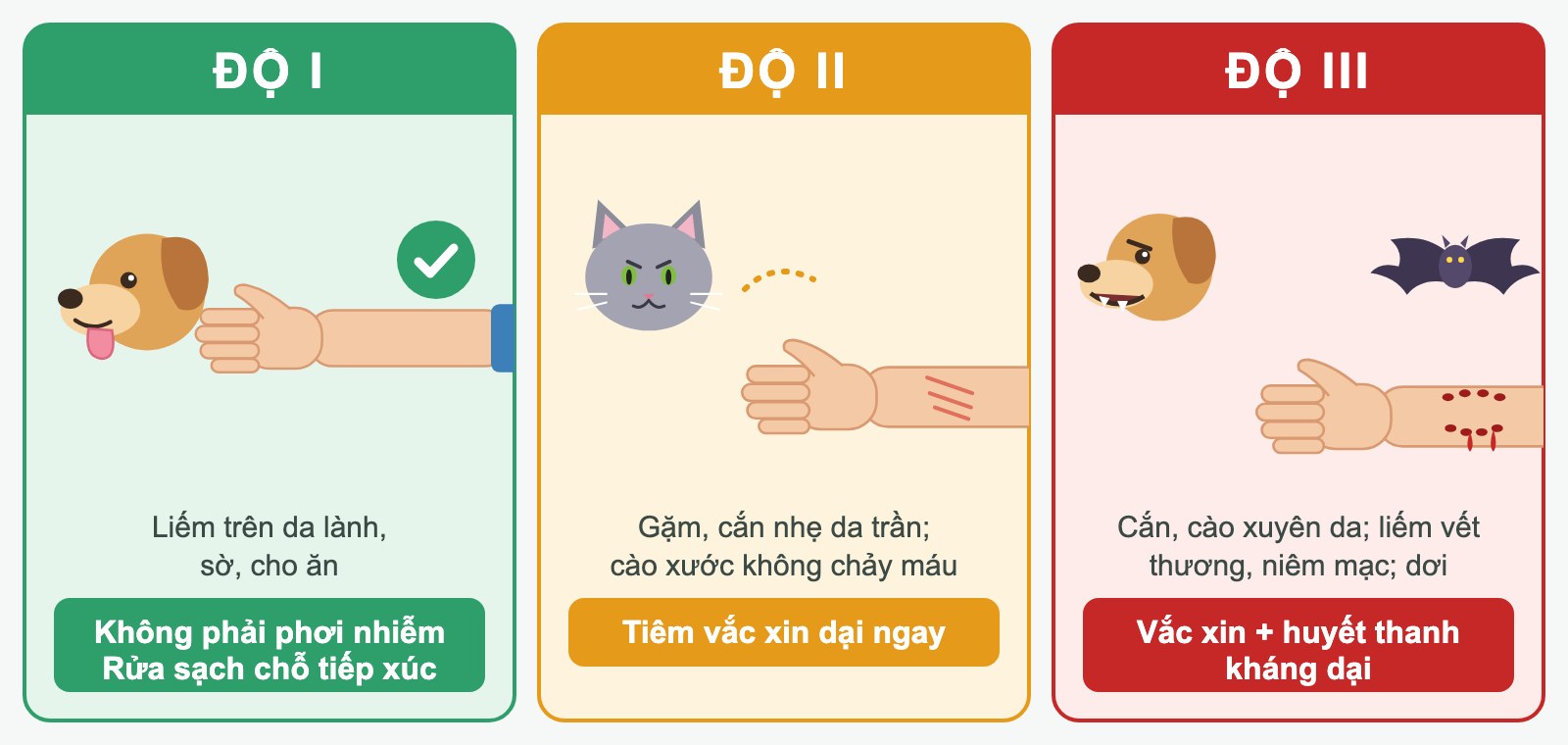
Category I
Touching or feeding the animal; licks on intact skin.
Not an exposure. Wash the area of contact.
Category II
Nibbling of uncovered skin; minor scratches or abrasions without bleeding.
Rabies vaccination straight away.
Category III
One or more bites or scratches that break the skin; licks on broken skin or on mucous membranes (eyes, mouth); contact with bats.
Rabies vaccine and rabies immunoglobulin.
Rabies vaccination date calculator
Choose the schedule prescribed by the health worker and the date of exposure (or the date of the first dose for pre-exposure prophylaxis).
Rabies vaccination schedules
Post-exposure – 5 intramuscular doses (days 0, 3, 7, 14, 28)
| Dose | Day (from exposure) | Minimum interval from previous dose |
|---|---|---|
| Dose 1 (day 0) | Day 0 | – |
| Dose 2 (day 3) | Day 3 | 3 days |
| Dose 3 (day 7) | Day 7 | 4 days |
| Dose 4 (day 14) | Day 14 | 7 days |
| Dose 5 (day 28) | Day 28 | 14 days |
Each dose is one intramuscular dose (deltoid muscle; young children in the anterolateral thigh). Category III exposure also requires rabies immunoglobulin as prescribed. If the animal is observed and remains healthy after 10–15 days, the health worker may stop the vaccination. After an animal bite or scratch: wash the wound immediately with soap and plenty of clean water for about 15 minutes, disinfect it, then go to a health facility to have the exposure assessed. The schedule in the app is only a reminder and does not replace a health worker's prescription.
Source: Ministry of Health Decision 1622/QĐ-BYT of 08/5/2014 – Guidance on surveillance, prevention and control of human rabies (1622/QĐ-BYT). Reviewed on 05/10/2026.
Post-exposure – intradermal (days 0, 3, 7, 28)
| Dose | Day (from exposure) | Minimum interval from previous dose |
|---|---|---|
| Visit 1 (day 0) – 2 intradermal sites | Day 0 | – |
| Visit 2 (day 3) – 2 intradermal sites | Day 3 | 3 days |
| Visit 3 (day 7) – 2 intradermal sites | Day 7 | 4 days |
| Visit 4 (day 28) – 2 intradermal sites | Day 28 | 21 days |
Each visit gives 2 intradermal injections (0.1 ml each), only at facilities with staff trained in intradermal injection. Category III exposure also requires rabies immunoglobulin as prescribed. After an animal bite or scratch: wash the wound immediately with soap and plenty of clean water for about 15 minutes, disinfect it, then go to a health facility to have the exposure assessed. The schedule in the app is only a reminder and does not replace a health worker's prescription.
Source: Ministry of Health Decision 1622/QĐ-BYT of 08/5/2014 – Guidance on surveillance, prevention and control of human rabies (1622/QĐ-BYT). Reviewed on 05/10/2026.
Re-exposure – people previously fully vaccinated (days 0, 3)
| Dose | Day (from exposure) | Minimum interval from previous dose |
|---|---|---|
| Dose 1 (day 0) | Day 0 | – |
| Dose 2 (day 3) | Day 3 | 3 days |
For people with documented pre-exposure prophylaxis or a completed post-exposure course. Rabies immunoglobulin is usually not needed. The health worker decides the schedule based on the time since the previous vaccination. After an animal bite or scratch: wash the wound immediately with soap and plenty of clean water for about 15 minutes, disinfect it, then go to a health facility to have the exposure assessed. The schedule in the app is only a reminder and does not replace a health worker's prescription.
Source: Ministry of Health Decision 1622/QĐ-BYT of 08/5/2014 – Guidance on surveillance, prevention and control of human rabies (1622/QĐ-BYT). Reviewed on 05/10/2026.
Pre-exposure prophylaxis – 3 doses (days 0, 7, 21 or 28)
| Dose | Day (from first dose) | Minimum interval from previous dose |
|---|---|---|
| Dose 1 (day 0) | Day 0 | – |
| Dose 2 (day 7) | Day 7 | 7 days |
| Dose 3 (day 21 or 28) | Day 21 | 14 days |
| Booster (after 1 year, then every 5 years) Booster | Day 365 | 330 days Booster every 5 years |
For people at high risk: veterinary workers, forest rangers, rabies laboratory staff, people living in or travelling to high-risk areas, and children in endemic areas. Boosters as prescribed by a health worker.
Source: Recommended vaccination schedules for all ages in Vietnam (2026 edition). Reviewed on 07/10/2026.
About rabies
Transmission
Saliva of rabid animals (dogs, cats, bats…) transmitted through bites, scratches, or licks on mucous membranes or broken skin.
Symptoms
At first, itching or burning at the wound, fever and anxiety; then the furious form (fear of water and of drafts, agitation) or the paralytic form.
Course of illness
Acute encephalomyelitis, cardiac and respiratory arrest. ALMOST 100% FATAL once symptoms appear.
Who should get pre-exposure prophylaxis
People bitten by dogs or cats, veterinary workers, forest rangers, slaughterhouse workers.